Inventing a Nation by Gore Vidal & Jefferson
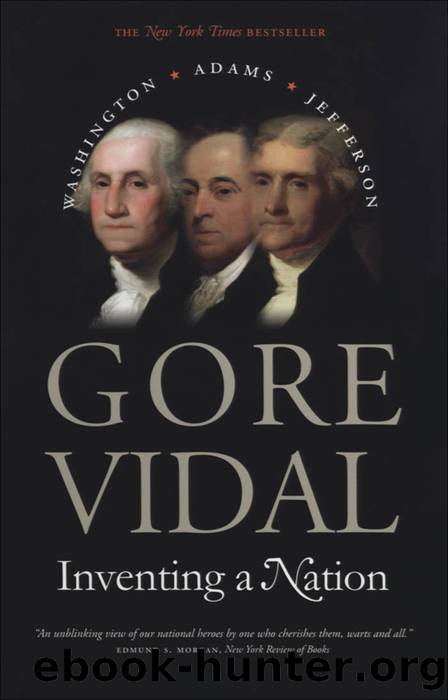
Author:Gore Vidal & Jefferson
Language: eng
Format: epub
Publisher: Yale University Press
Published: 2003-11-15T00:00:00+00:00
Between 1793 and 1797 the farmer-philosopher Jefferson seems to have undergone what a later generation would term a midlife crisis, to which he alludes, April 27, 1795, in a letter to Madison, the acknowledged leader of the Republican Party, whose idol wasâJefferson himself. âMy health,â he writes Madison, âis entirely broken down within the last eight months.â Yet at fifty, he was not about to relinquish his web of political operatives while, simultaneously, building and rebuilding Monticello and farming (wheatânot tobacco). Of this curious period, he later writes to his daughter Polly, âFrom 1793 to 1797, I remained closely at home, saw none but those who came there, and at length became very sensible of the ill effect it had upon my own mind, and of its direct and irresistible tendency to render unfit for society, and uneasy when necessarily engaged in it. I felt enough of the effect of withdrawing from the world then, to see that it led to an antisocial and misanthropic state of mind, which severely punishes him who gives in to it.â Although for thirty-seven months Jefferson never strayed more than seven miles from Monticello, he wrote letters, read newspapers, received visitors. One year after he had settled into his âretirement,â Madison was putting him forward as Republican candidate for president against âthe British party.â
Alexander Hamilton had resigned as secretary of the treasury January 31, 1795, a Saturday; on the following Monday, Washington accepted the resignation, coolly: âIn every relation which you have borne to me, I have found that my confidence in your talents, exertions and integrity has been well placed.â On February 3 Hamilton replied, âAs often as I may recall the vexations I have endured, your approbation will be a great and precious consolation. You will always have my fervent wishes for your public and private felicity.â
In politics mutual need, no matter how temporary, is all that matters. For the moment, Hamilton was now free to return to New York City, to the law, to his compulsive political conniving, and he would not return until the president needed him for one final task; the composition of the presidentâs Farewell to the Nation, a sort of credo which would prove to be, after the extraordinary insight that a national debt, properly administered, is the secret of national wealth, Hamiltonâs (and Washingtonâs) enduring legacy to the American system. Washingtonâs original cabinet was, finally, dispersed except for Edmund Randolph, now secretary of state.
In London, John Jay had concluded a treaty with England which Lord Grenville and he had signed. But as of March 4, the day that Congress adjourned, no copy of the treaty had arrived, making it impossible for the Senate to give or withhold its advice and consent. Washington and Randolph were rightly nervous as to the treatyâs contents.
Finally, on March 7, âThe Treaty of Amity, Commerce and Navigationâ arrived, accompanied by Jayâs bleak note to Washington: âIt must speak for itself. . . . To do more was not possible.â What the
Download
This site does not store any files on its server. We only index and link to content provided by other sites. Please contact the content providers to delete copyright contents if any and email us, we'll remove relevant links or contents immediately.
| Anthropology | Archaeology |
| Philosophy | Politics & Government |
| Social Sciences | Sociology |
| Women's Studies |
The Secret History by Donna Tartt(19466)
The Social Justice Warrior Handbook by Lisa De Pasquale(12291)
Thirteen Reasons Why by Jay Asher(9110)
This Is How You Lose Her by Junot Diaz(7054)
Weapons of Math Destruction by Cathy O'Neil(6465)
Zero to One by Peter Thiel(5943)
Beartown by Fredrik Backman(5927)
The Myth of the Strong Leader by Archie Brown(5623)
The Fire Next Time by James Baldwin(5579)
How Democracies Die by Steven Levitsky & Daniel Ziblatt(5321)
Promise Me, Dad by Joe Biden(5228)
Stone's Rules by Roger Stone(5185)
A Higher Loyalty: Truth, Lies, and Leadership by James Comey(5082)
100 Deadly Skills by Clint Emerson(5023)
Rise and Kill First by Ronen Bergman(4890)
Secrecy World by Jake Bernstein(4868)
The David Icke Guide to the Global Conspiracy (and how to end it) by David Icke(4842)
The Doomsday Machine by Daniel Ellsberg(4618)
The Farm by Tom Rob Smith(4599)
